Let’s carefully collaborate our way through the ongoing Covid 19 crisis, and help drive the post pandemic recovery and growth. Luckily we were already set up for working with you remotely, so we can seamlessly support your new designs/products or analysis so that you can to be ready, and your projects still on time. To adapt to the new reality of Covid19, there has had to be a few subtle changes to the way we operate – but it’s all very sensible. We have adapted our protocols to operate normally while protecting our own staff (even from each other) Our Couriers are still running so sending and receiving devices/boards/samples is still normal. Our free project consultancy is unchanged via telephone and via video conferencing. We have upgraded the bandwidth and refresh times of our LiveFIB and LiveOPTICAL remote consultancy/microscopy options – you can still visit to supervise your work being done – but now ‘virtually’. This also saves non-urgent travel risks and costs. Sample handling is always done in sterile conditions, and return shipping is in sterile packaging. For you this means No new risks for you for handling, shipping, discussing and supervising external projects. No new project delays, lower costs (no travel), less time needed for documentation (virtual meetings), same rapid project turnaround, same professional – confidential – expert service. Extremely low exchange rates – so if you pay in Dollars or Euro’s, you have a historically lower cost. So even if you are now working from home, and things could be better – Better call NanoScope Lloyd.Peto@NanoScopeServices.com +44(0)7768...
Our latest newsletter covers: New Services complement our Inspection and Analysis Options New AFM capability for rapid turn high resolution surface analysis High-resolution thermal imaging of chips and ICs – a great complement to our existing nano-surgery services X-Ray imaging for detailed inspection of a device’s internal structure and connections Acoustic Microscopy (CSAM) for detailed before/after checks. Download it here – E-Newsletter Summer...
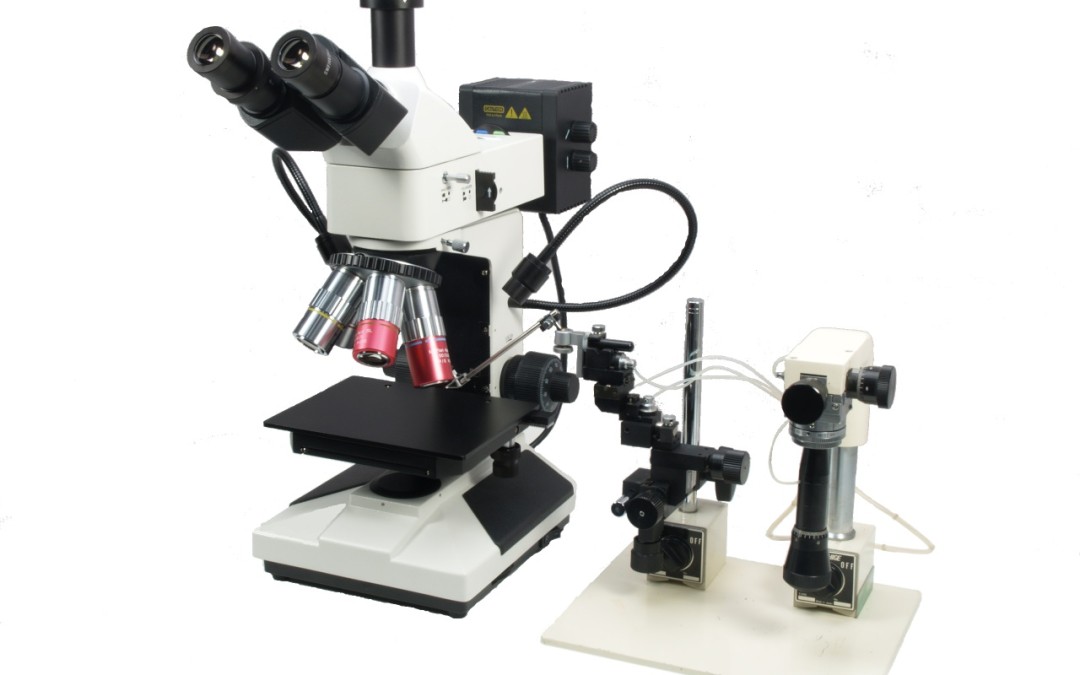
The perfect addition to any FIB or FIB-SEM laboratory, a high performance optical microscope with ultra long working distance lenses and an ‘ex-situ‘ FIBxTEM section lift-out manipulator. Go to the full product description here. Our engineers (in previous roles) configured and supplied the first version of the ex-situ lift out system to all international FIB and FIB-SEM markets for over 10 years. Now we have created a new ‘best in class’ configuration to maximise the benefits of the ex-situ approach across the widest range of materials systems. If you are not sure of the advantages of ex-situ vs in-situ, read our technical article describing all the pro’s and con’s of both techniques here. The new system configuration has been developed with the experience gained from making FIBxTEM sections from over 300 different materials systems over the last 20 years. From catalytic converters to teeth, Indium Antimonide to car paint and carbon fibre composites and nuclear fuel rod liners to aerogel, we’ve used this technique to make successful FIBxTEM sections from all these materials systems, so we know what works and more importantly, what doesn’t. Changes to the stage design, combination lighting sources and lenses, ensure that the system delivers the highest success rate possible. In addition we have taken advantage of new manufacturing capabilities and techniques, so the system is far more economical than any other ex-situ lift-out solution which has been offered until now. Our fully capable ‘ECO’ configuration is available for £19,650 (€24,955) with immediate delivery. To see the full product description and specifications go to the lift-out page here. Or to get a PDF brochure click...
Press Release 25th June 2014 – Bristol, UK Agar Scientific and NanoScope Services sign collaborative agreement to offer advanced TEM sectioning services. NanoScope Services Ltd., a focused ion beam (FIB) and microscopy laboratory based in Bristol, UK, and Agar Scientific, a wholly owned subsidiary of Elektron Technology UK Ltd. and renowned supplier of microscopy products based in Stansted, UK, have teamed up to offer a unique section preparation service for transmission electron microscopy (TEM) to materials scientists across Europe and beyond. This new FIB technique offers several key technical advantages over conventional mechanical and broad beam section preparation techniques, particularly for complex or difficult materials systems. FIB sections permit a relatively large viewing area in the TEM and may be prepared from very specific features with a minimal amount of mechanical preparation required prior to starting the process. “This new service has been specifically tailored to the needs of industrial and academic materials scientists, giving them easy access to turn-key sectioning services that can save them significant time,” said Lloyd Peto, Commercial Director at NanoScope Services. “Agar Scientific is the perfect partner for us in this market.” Darren Likely, Business Unit Director at Elektron Technology Uk Ltd., added “Agar has a terrifically wide selection of products and accessories to support our sophisticated customer base, and we are pleased to now be able to add outsourced services to this list. The TEM section preparation service from NanoScope has the technical and commercial quality that our customers have come to expect from Agar.” The new TEM section preparation service will be offered through the Agar on-line catalogue and is part of...
NanoScope FIB technology article. Just posted here is the full article discussing the relative merits of both methods of FIBxTEM section extraction and the factors to consider when choosing which is better for your sample types. You may think the answer is a foregone conclusion, with in-situ foil extraction being clearly more advanced and more effective as an extraction method than ex-situ, but hold on to that thought, as there may be some less obvious issues that are worth your consideration. Included here is a detailed analysis of each of these rival techniques across the following areas of applicability – 1st Speed – with the hands down winner being ex-situ 2nd Yield – more controversial with advocates on both sides 3rd Quality issues (of the section produced) 4th Cost – a clear winner here 5th Versatility – not such a common topic but vital for TEM users 6th Ease of use – this must be a slam dunk or? 7th Special circumstances Lets just check our terms and the common perception of what’s what for this technique. FIBxTEM section or foil = The site specific FIB milled sample biopsy that is FIB polished to become electron transparent and extracted to a TEM grid before being transferred to a TEM microscope for more detailed studies. ‘in-situ’ foil extraction – where a ‘thick’ biopsied section is transferred to a TEM grid inside the FIB-SEM instrument using a nano-manipulator and attached there before being FIB polished to the required ‘thinness’ and then transferred to a TEM. ‘ex-situ’ foil extraction – where a site specific feature is thinned to electron transparency BEFORE extraction, then...
NanoScope is bringing additional capabilities in house – from Unisem. Unisem has been a key supplier for NanoScope Services for many years, and we have worked closely together to offer our clients the best support available from both sites. The unfortunate recent closure of the Unisem Crumlin site has been widely seen as a reduction in the strategic capabilities of the UK semiconductor industry, both in terms of the equipment available but also the extensive experience of the engineers who worked there. However, NanoScope has been successful in acquiring much of the FA capability of the Unisem facility and we are now in the process of transferring this equipment over to our Bristol Laboratory. We plan to offer Dual-acid decapsulation from early February 2014, with even shorter turnaround times than previously, with other techniques to follow. For more information please contact Lloyd Peto at NanoScope on 07768 172049 Or email...




Recent Comments